Write to us:
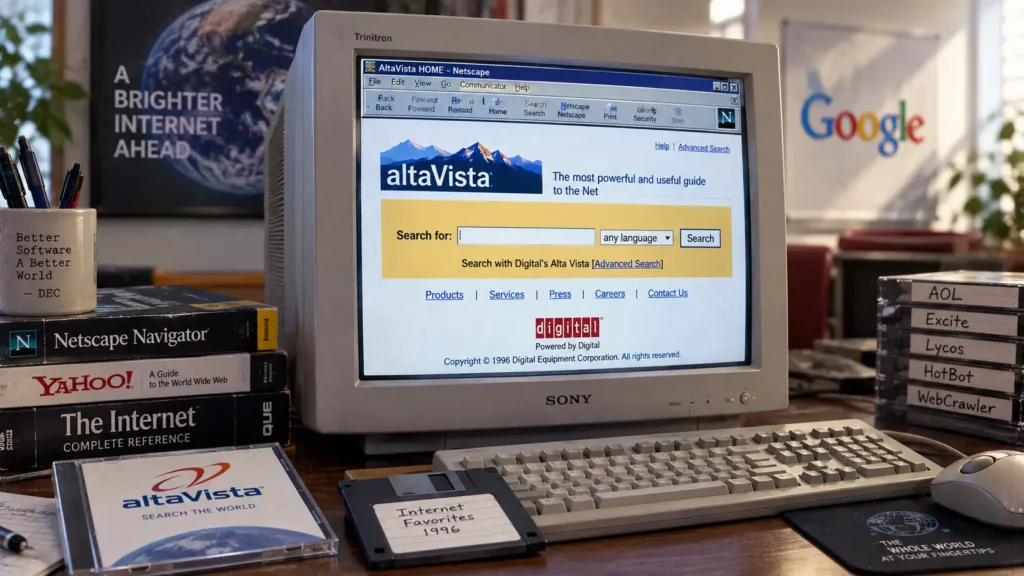

Before Google became a verb, there was AltaVista.
In the mid-1990s, the Web was growing faster than anyone could organize it. Websites were appearing everywhere, but finding something useful was still a challenge. There were directories, portals, bookmarks and lists in magazines, yet there was no reliable way to search the Web as a whole.
Then came AltaVista, one of the first major search engines built to crawl and index the rapidly growing Web.
Launched publicly on December 15, 1995, AltaVista was one of the most technically advanced search engines of its time. It could crawl and index an enormous amount of Web content, return results quickly and give users more control over their searches.
For a while, AltaVista looked like the future of Internet search.
Then Google arrived.
The Web Was Becoming Impossible to Navigate
In the early days of the Web, finding a website was often a matter of knowing where to look.
Users relied on:
- Human-curated directories
- Bookmarks
- Magazine lists
- Links shared through forums and mailing lists
- Internet portals such as Yahoo!, Excite and Lycos
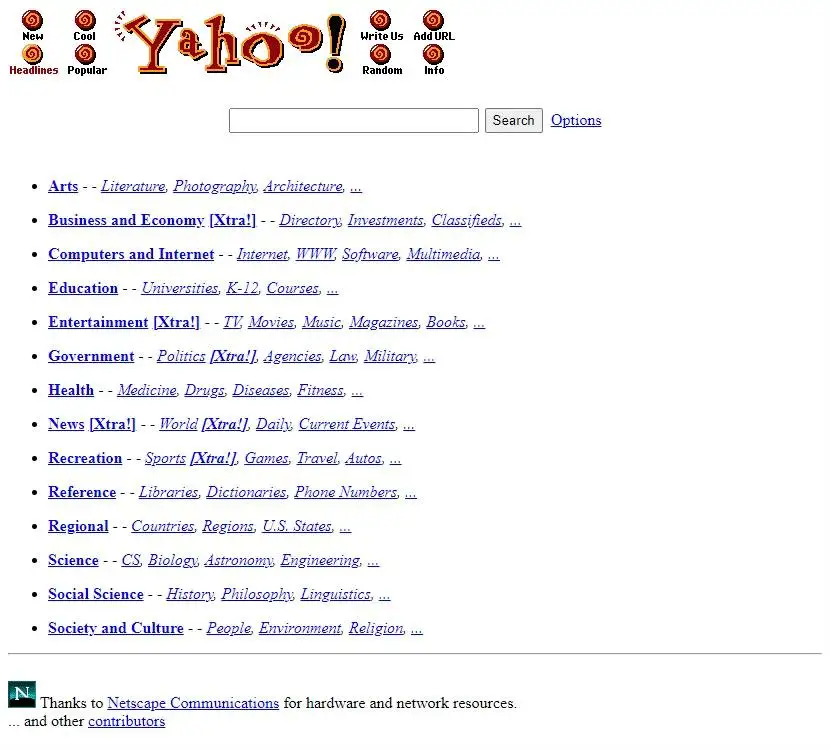
Yahoo! was building a directory by sending people to websites, categorizing them and organizing them into sections.
But the Web was expanding too quickly.
By the middle of the 1990s, there was an obvious problem:
How do you search something that nobody has finished cataloguing?
AltaVista was one of the first serious answers.
Born Inside Digital Equipment Corporation
AltaVista did not begin as a consumer Internet startup.
It came from Digital Equipment Corporation, better known as DEC, one of the major computer companies of the era.
In 1995, researchers at DEC’s Western Research Laboratory in Palo Alto were experimenting with powerful computers and new ways to process enormous amounts of information.
Paul Flaherty proposed using that computing power to crawl the Web. Louis Monier developed the crawler, while Michael Burrows worked on the indexing technology.
The result was AltaVista.
On December 15, 1995, the service opened to the public with an index of approximately 16 million Web pages — an extraordinary figure for the time.
It received around 300,000 searches on its first day.
Almost immediately, people noticed that AltaVista was different.
How the AltaVista Search Engine Worked
The magic of AltaVista was its scale.
Instead of relying primarily on people to organize websites, AltaVista used automated software to crawl the Web and build a searchable index.
Users could type a word or phrase and search across a huge collection of pages.
For 1995, that felt revolutionary.
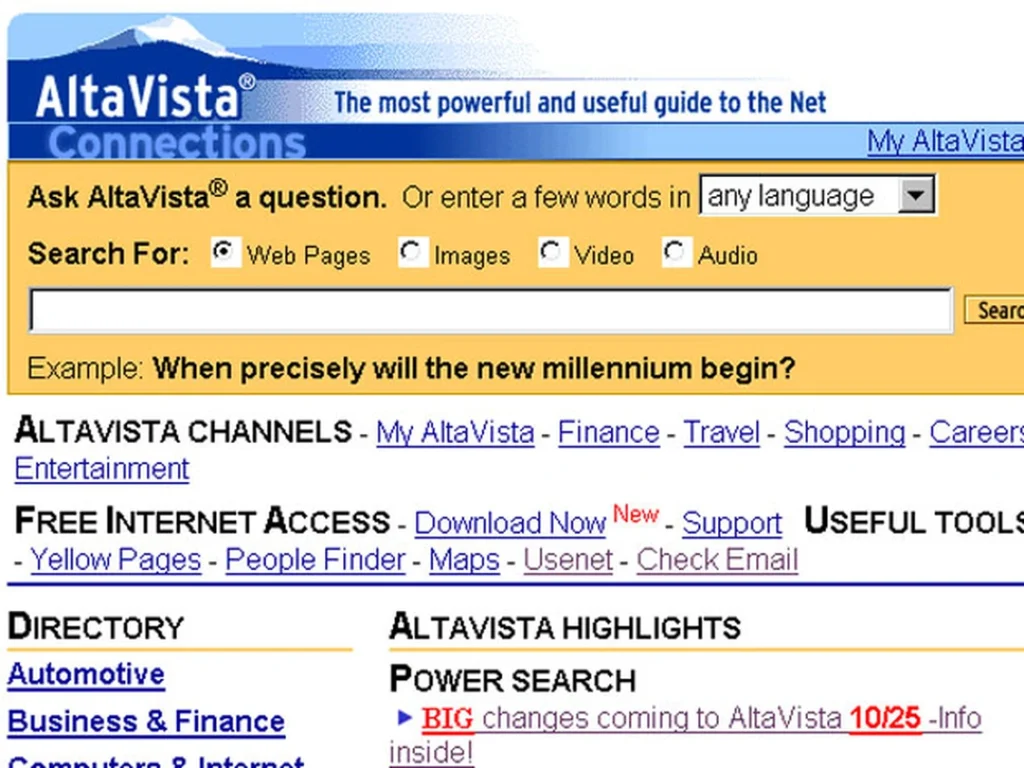
AltaVista also offered sophisticated search operators, including Boolean commands that allowed users to combine terms, exclude words and narrow their results. Experienced users could search with much more precision than was possible through a basic directory.
The Web suddenly felt less like a collection of disconnected islands and more like one enormous database.
AltaVista’s Early Advantages
Huge index
It could crawl and index an extraordinary amount of Web content for its time.
Fast results
Searches that previously felt cumbersome could be returned remarkably quickly.
Advanced search
Boolean operators and other tools gave experienced users more control.
A new way to navigate
You did not necessarily need to know where information lived. You could search for it.
300,000 Searches on Day One
AltaVista’s growth was almost immediate.
The service received approximately 300,000 requests on its first day. Within a few weeks, daily traffic had reportedly reached millions of searches.
By 1997, AltaVista was processing more than 80 million requests per day.
The Internet was becoming mainstream, and AltaVista was becoming one of its gateways.
For a generation of early Internet users, the AltaVista search box was one of the first places they went when they did not know where to start.
Yahoo! Had the Directory. AltaVista Had the Web.
The contrast between Yahoo! and AltaVista reveals how the early Web worked.
Yahoo! was essentially trying to organize the Internet.
Human editors visited websites, categorized them and added them to a directory.
AltaVista was taking a different approach:
Let the machines crawl it.
That difference became increasingly important as the number of websites grew.
Humans could review and categorize only so many pages. Automated search engines could process far more information, even if their results were not always perfect.
The future belonged to automated search.
AltaVista was already there.
When AltaVista Became a Portal
AltaVista’s technology was impressive, but its business identity was less clear.
Was it a search engine?
A portal?
An Internet destination?
A technology showcase?
A complete online company?
After Compaq acquired Digital Equipment Corporation in 1998, AltaVista became part of a much larger corporate structure. Its strategy began to change.
AltaVista expanded beyond search into:
- News
- Shopping
- Finance
- Entertainment
- Other online services
Like Yahoo!, Excite and Lycos, AltaVista was becoming an Internet portal.
That decision came at exactly the wrong moment.
While AltaVista was trying to become the place where people spent time online, another company was becoming the place where people simply found things.
Then Google Arrived
Google appeared in 1998.
Its founders, Larry Page and Sergey Brin, were developing a different way to rank websites. Their PageRank system treated relationships between websites — including links pointing from one page to another — as important signals when determining relevance.
The result was a search engine that often seemed remarkably good at answering a simple question:
Which result should I click?
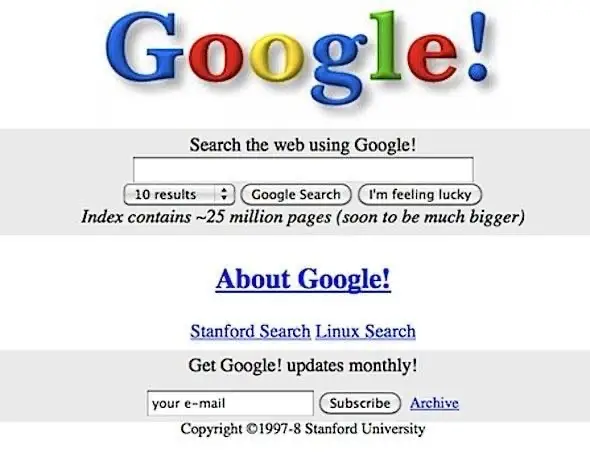
Google’s homepage was also almost absurdly simple.
There was no news feed, shopping section, email interface or crowded portal layout.
There was a logo, a search box and a button.
That simplicity was not a lack of ambition.
It was a clear product decision.
Google focused on helping users find useful information as quickly as possible.
The Battle Wasn’t Over Yet
It is easy to look back at history and assume Google immediately destroyed AltaVista.
It did not.
AltaVista remained hugely popular after Google launched.
In 2000, one Media Metrix measurement placed AltaVista at approximately 17.7% of Internet users, compared with roughly 7% for Google.
Google was still the newcomer.
AltaVista had:
- The brand
- The traffic
- The technology
- The head start
- A large base of loyal users
But the Internet was changing, and Google’s focus was becoming increasingly clear.
Search.
AltaVista’s Billion-Dollar Moment
During the dot-com boom, AltaVista became one of the Internet’s most valuable companies.
In 1999, CMGI acquired a majority stake in AltaVista in a deal that valued the company at approximately $2.3 billion.
An initial public offering was planned, and the company spent heavily as investors expected the Internet economy to expand indefinitely.
AltaVista looked like one of the giants of the new digital world.
But the dot-com bubble was about to burst.
When technology stocks collapsed, Internet companies that had seemed almost unstoppable suddenly faced a very different financial reality.
From Billions to $140 Million
By 2003, AltaVista’s position had changed dramatically.
Overture Services acquired the company for approximately $140 million.
Later that year, Yahoo! acquired Overture, bringing AltaVista into Yahoo!’s growing search empire.
The independent search engine that had once looked like a potential Internet giant was gradually becoming a legacy brand.
Google, meanwhile, was pulling further ahead.
Why Did AltaVista Lose to Google?
The answer is not simply that Google had better technology.
AltaVista had excellent engineering.
Its problem was a combination of strategic, corporate and market-related factors.
1 – It Lost Focus
AltaVista moved from search toward the portal model that dominated the late 1990s.
Google remained relentlessly focused on search.
2 – Ownership Kept Changing
AltaVista passed through several corporate structures during a period when the Internet was changing incredibly quickly.
Each ownership change brought new priorities, new strategies and new expectations.
3 – The Dot-Com Crash Changed Everything
The collapse of the dot-com bubble transformed the economics of Internet companies almost overnight.
Expansion was no longer enough.
Companies had to prove that their businesses could survive.
4 – Google’s Search Quality Improved
Google’s ranking approach gave it a powerful advantage as the Web became larger and more complex.
Finding pages was no longer the main challenge.
Finding the most relevant page was.
5 – Google Understood Simplicity
Google recognized something many portals overlooked:
Sometimes people do not want another destination. They just want an answer.
The Strange Case of Babel Fish
AltaVista was not only about search.
One of its most memorable side projects was Babel Fish, an online translation service that became available through AltaVista in the late 1990s.
Babel Fish could translate text and Web pages between several languages.
Today, machine translation feels ordinary.
In the late 1990s, however, pasting text into a website and receiving an automated translation felt almost futuristic.
The service became part of early Internet culture and was later absorbed into Yahoo!’s online services.
Its name came from the fictional translation device in The Hitchhiker’s Guide to the Galaxy.
Babel Fish was not always accurate, but it introduced many users to the idea that the Web could be translated on demand.
The End of AltaVista
By the 2010s, AltaVista was a shadow of its former self.
Google had become synonymous with search.
Yahoo! was fighting to remain relevant.
Microsoft had launched Bing.
AltaVista was increasingly a historical name rather than a serious competitor.
Yahoo! announced that AltaVista would be discontinued as part of a wider product shutdown.
On July 8, 2013, the service went offline and visitors were redirected to Yahoo Search.
After nearly 18 years, AltaVista disappeared from the Web.
There was no dramatic farewell.
No final homepage.
Just a redirect.
What AltaVista Left Behind
AltaVista did not beat Google.
But that is not really the point.
It helped establish one of the most important ideas in modern Internet history:
The Web could be searched.
Before search engines became invisible infrastructure, that was a revolutionary concept.
AltaVista showed that computers could crawl enormous amounts of information, index it and return results almost instantly.
Google refined that idea and eventually dominated it.
But AltaVista helped prove that searchable Web content could become a practical everyday tool.
The Internet Before Google
Today, it is difficult to imagine a world in which Google was not the default answer.
Search has become so deeply embedded in everyday life that we barely notice it.
We search for news, products, directions, images, definitions and answers without thinking about the infrastructure that makes those results possible.
But the Internet was not always like this.
There was a time when Yahoo!, AltaVista, Lycos, Excite, Infoseek, WebCrawler and dozens of other services were competing to become the place where the Web began.
AltaVista was one of the most important — and perhaps the most interesting.
Google did not simply replace a problem AltaVista had failed to solve.
Google inherited a problem AltaVista had already helped define:
How do you make sense of an Internet that is growing too quickly to understand?
AltaVista had one answer.
Google had another.
Only one of them survived.
GLITCHBACK
AltaVista disappeared in 2013.
Google never did.
But if you spent time online in the 1990s, there was a moment when the future of search did not seem inevitable.
There was no guarantee that Google would become synonymous with searching the Web.
There was AltaVista.
There was Yahoo!.
There were portals everywhere.
The Internet was still figuring itself out.
For a brief moment, AltaVista was one of the companies showing us what the searchable Web could become.
It had the technology.
It had the audience.
It had the opportunity to define the future.
Then the search box changed.
And the rest is Internet history.
Related Glitchback
Search Engines Before Google
Before Google became the default way to explore the Web, dozens of search engines competed to organize the growing Internet.
What was AltaVista?
AltaVista was a pioneering search engine launched in 1995 by Digital Equipment Corporation. It became one of the most popular ways to search the Web during the 1990s.
Was AltaVista better than Google?
AltaVista was one of the leading search engines when Google launched in 1998. Google later gained a larger share of the search market as its ranking technology and search experience developed.
What happened to AltaVista?
Yahoo! discontinued AltaVista on July 8, 2013, redirecting visitors to Yahoo Search.
When did AltaVista shut down?
AltaVista officially shut down on July 8, 2013, after almost 18 years online.
What search engines existed before Google?
Major search engines before and around Google’s early years included AltaVista, Yahoo!, Lycos, Excite, Infoseek and WebCrawler.