Write to us:
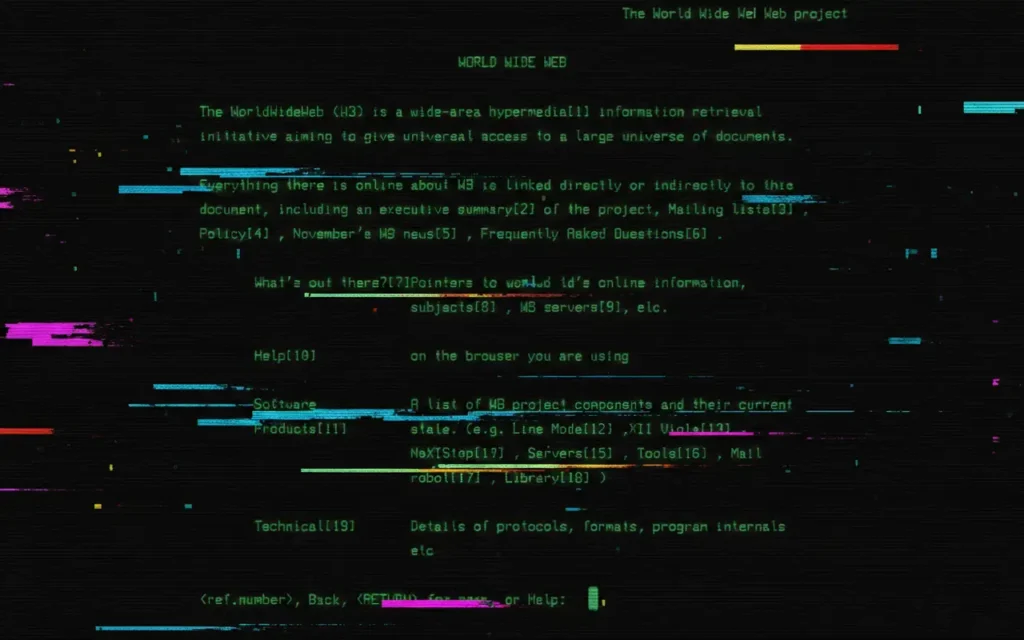

In the wild digital frontier of the early 1990s, when the internet was more science experiment than global powerhouse, one page changed everything. Ever wondered what was the first website ever created? Spoiler: it wasn’t flashy ads or cat videos, it was a humble info dump about how to use the web itself. Launched on August 6, 1991, by Tim Berners-Lee, this pioneering site kicked off the World Wide Web revolution.
If you’re nostalgic for dial-up screeches and blinking cursors (like us here at Glitchback), buckle up. This deep dive uncovers the first website ever, its creator, the tech behind it, and why it still echoes in today’s SEO obsessed blogs. We’ll trace its birth at CERN, explore forgotten archives, and geek out on how it paved the way for sites like yours.
The Man Behind the First Website: Tim Berners-Lee’s Vision
Imagine a physicist in a Swiss lab, frustrated by clunky file sharing. That’s Sir Tim Berners-Lee, a British computer scientist working at CERN (the European Organization for Nuclear Research) in 1989. He didn’t set out to invent the internet, ARPANET beat him there in the 1960s, but he dreamed up the World Wide Web as a way to link documents across computers.
Berners-Lee proposed a “hypertext” system in a memo titled Information Management: A Proposal. By 1990, he’d coded the essentials:
- HTML (HyperText Markup Language) for structure.
- HTTP (HyperText Transfer Protocol) for transferring pages.
- URL (Uniform Resource Locator) for addressing them.
- A basic browser/editor called WorldWideWeb (later Nexus).
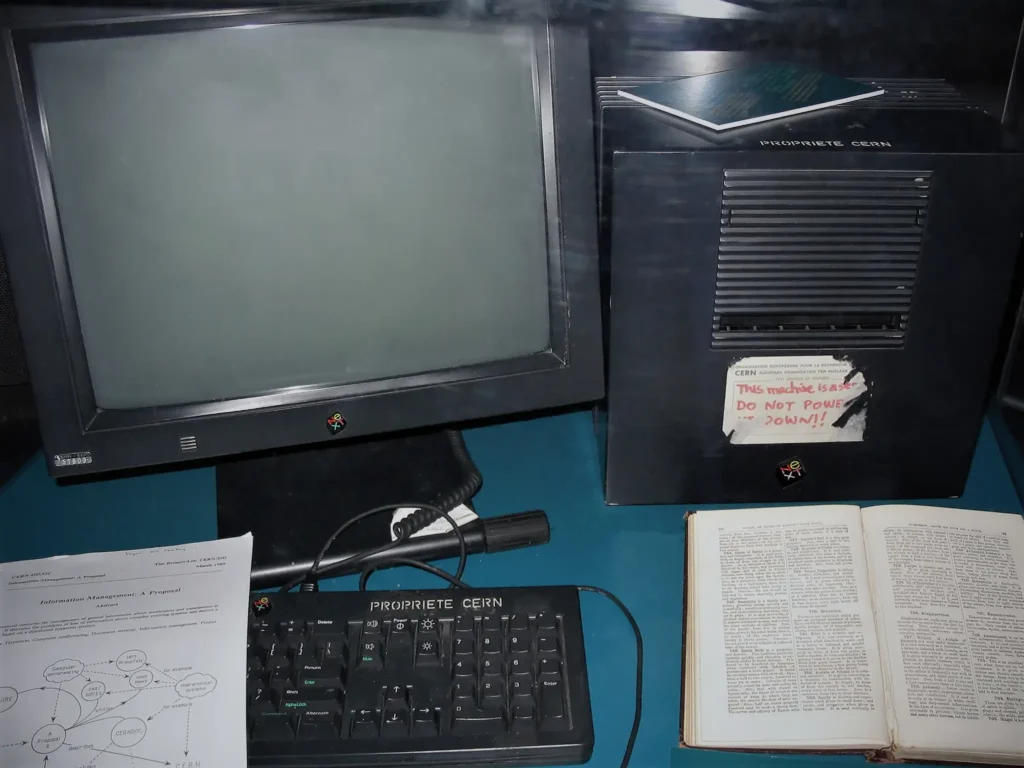
No venture capital, no hype, just pure invention. On Christmas Day 1990, he connected it all on his NeXT computer. But the world wouldn’t see it until that fateful August day in 1991.
Fun fact: Berners-Lee released the code for free, seeding the web’s open ethos. Without that, no Google, no Facebook, no Glitchback.com.
The Launch: August 6, 1991
The first website ever created went live at 10 p.m. Central European Time on August 6, 1991. Its URL? http://info.cern.ch, still accessible today via CERN’s archives.
This wasn’t a “site” like modern ones with CSS grids and JavaScript animations. It was a single directory of plain-text files, viewable only on NeXT machines initially. To access it, you needed:
- A NeXT computer (pricey, Steve Jobs’ baby).
- CERN’s internal network.
- The line mode browser Berners-Lee built.
The homepage screamed utility: “The World Wide Web” in big, bold header tags. It welcomed users with:
Welcome to the World Wide Web.
The WorldWideWeb (WWW) is a wide-area hypermedia information retrieval initiative aiming to give universal access to a large universe of documents.
Everything was instructional, how to set up a server, create hyperlinks, or join the www-talk mailing list. No images, no forms, just raw hypertext links to subpages like:
- “Getting Started” (setup guides).
- “Finding Information” (early search tips).
- “Project Overview” (web philosophy).
- “CERN WWW Manager” (contact info).
It embodied 90s minimalism: black text on beige, slower than molasses on dial-up. Yet, it was revolutionary democratizing info sharing for scientists worldwide.
Peeking Into the First Website’s Pages
CERN restored the site in 2013 for its 20th anniversary, letting us time-travel. Here’s a breakdown of its key sections:
- What is the WWW Project? Explained hypertext as “groups of documents much like books, but with cross-references.”
- Why a Web? Solved siloed data problems at CERN, where thousands of researchers juggled formats.
- How Can I Become a WWW Provider? Step-by-step server setup, eerily like today’s WordPress installs.
- How Can I Access My Files? Browser instructions, including FTP fallbacks.
| Original Page | Purpose | Modern Equivalent |
|---|---|---|
| Getting Started | Install browser/server | WordPress dashboard setup |
| Filling in Forms | Early data input | Contact forms/plugins |
| Protocols | HTTP explained | API integrations |
| Help on the Browser | Usage tips | Browser dev tools |
These pages weren’t pretty, but they worked. By late 1991, servers popped up in Europe and the US.
The Tech Stack: How the First Website Ever Actually Worked
Diving deeper, the first website ever ran on bleeding-edge (for 1991) tech:
- Hardware: NeXTstation, a cube-shaped Unix workstation with a 68040 CPU and 8MB RAM. Cost? Around $5,000—more than a used car.
- Software: Berners-Lee’s custom HTTP daemon (server) and libwww library.
- Markup: HTML 0.9—tags like
<TITLE>,<H1>,<A HREF>. No<IMG>yet (images arrived in 1993). - Network: TCP/IP over CERN’s Ethernet, pre-dating public internet backbones.
Code snippet from the original server (simplified):
textGET / HTTP/1.0
Response? A stream of HTML served instantly, no databases, no CDNs.
It was fragile, crashed often, supported only text. But it proved hypertext could scale.
Milestones: From Obscurity to Global Explosion
The first website ever didn’t go viral overnight (no social media anyway). Key timeline:
- 1991: Live at CERN; Berners-Lee posts to alt.hypertext Usenet group. First external access: October.
- 1992: 50 web servers worldwide. Marc Andreessen joins NCSA, builds Mosaic browser.
- 1993: Mosaic adds images, web traffic surges. CERN declares WWW public domain.
- 1994: First online purchase (pizza via Pizza Hut site). Yahoo! launches as a directory.
- 1995: Netscape IPO, commercial web booms.
By 1996, millions of sites existed. The original? Archived as servers modernized.

Challenges and Near-Deaths
CERN nearly killed it in 1994 amid funding woes, saved by public outcry. In 2013, they rebuilt it pixel-perfect using original code, hosted at http://info.cern.ch/hypertext/WWW/TheProject.html. Visit it today for that authentic 8-bit nostalgia.
Why the First Website Matters for Today’s SEO Pros and Bloggers
Fast-forward to 2026: You’re optimizing your blog, chasing “first website ever” rankings. But this relic teaches timeless lessons:
- User-First Design: It prioritized info over flash echoing Google’s “10 blue links” ethos.
- Link Building: Hyperlinks were core, today, they’re your backlink gold.
- Accessibility: Plain text loaded fast on slow connections, vital for Core Web Vitals.
- Open Source: Free code fueled growth, think WordPress’s 40% market share.
Nostalgic aside: Remember Geocities? That free hosting era stemmed directly from Berners-Lee’s generosity, birthing 90s web kitsch we adore.
Common Myths About the First Website Ever
Don’t fall for these:
- Myth: It had graphics. Nope, text only until 1993.
- Myth: Created by a company. Solo Berners-Lee project.
- Myth: Al Gore invented it. He championed funding ARPANET, not the web.
- Myth: Still the most visited. Nah, it’s a museum piece.
Wrapping Up: The First Website’s Lasting Legacy
The first website ever wasn’t built for fame, it was a tool for collaboration that accidentally birthed a trillion-dollar industry. From CERN’s labs to your WordPress dashboard, its DNA lives on in every hyperlink and SEO tweak.
FAQ: Quick Answers on the First Website Ever
The first website ever created was http://info.cern.ch, launched August 6, 1991, by Tim Berners-Lee at CERN.
Tim Berners-Lee, inventor of the World Wide Web.
Yes! Check CERN’s restored version at info.cern.ch
Plain black text on white, with headers and hyperlinks—no images or colors.
It demonstrated hypertext’s power, sparking the web’s explosive growth.