Write to us:

In the cutthroat cola wars of the 1990s, Pepsi and Coca-Cola battled for every sip of market share with increasingly audacious marketing stunts. But nothing captured the absurdity of corporate hype like the Pepsi Stuff promotion and the infamous Pepsi Harrier Jet lawsuit. Imagine this: a 21-year-old business student spots a TV ad promising a military fighter jet for 7 million Pepsi points. He crunches the numbers, raises the cash, and sues when Pepsi backs out. What followed was Leonard v. Pepsico, Inc., a landmark case in advertising law that forever changed how companies craft their promotions.
This isn’t just a quirky footnote in marketing history. It’s a masterclass in contract law, the “reasonable person” standard, and the fine line between hype and legal obligation. If you’ve ever wondered whether a TV commercial can create a binding contract, or why Pepsi had to add “just kidding” fine print to future ads, keep reading. We’ll dive deep into the story, the courtroom drama, and its lasting impact.
The Cola Wars Heat Up: Pepsi Stuff Goes Big
The mid-1990s marked peak cola wars, with Pepsi aggressively challenging Coca-Cola’s dominance through loyalty programs and viral campaigns. Enter Pepsi Stuff, a points-based rewards system launched in 1996. Customers collected points from bottle caps, cans, and 12 packs, then redeemed them for branded merchandise via a catalog. It was genius gamification, turn soda into swag.
A blockbuster TV ad sealed the deal. It opened with teens cashing in points for everyday cool:
- A T-shirt for 75 Pepsi points.
- Leather jacket for 1,450 points.
- Sunglasses for 175 points.
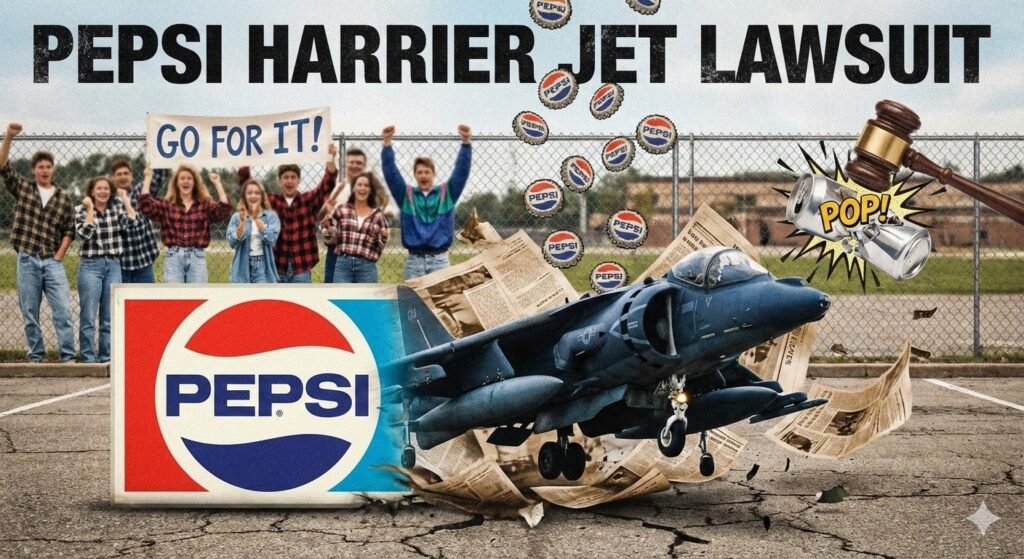
The energy built to a crescendo. Cut to a high school parking lot: a teenager lands an AV-8 Harrier Jump Jet, a real U.S. Marine Corps vertical takeoff fighter worth about $33 million. Confetti like newspapers swirl from the jet’s thrust as students cheer. He removes his helmet, grins at the camera, and the voiceover drops the bomb: “Harrier Fighter Jet: 7,000,000 Pepsi Points.”
Everyone laughed. A multimillion dollar warplane for soda caps? Pure absurdity. Or was it?
John Leonard Sees Opportunity, Not a Joke
Here comes John Leonard, a 21-year-old business student from Seattle, Washington. Watching that ad on TV, Leonard didn’t chuckle, he calculated. Crucially, the commercial never explicitly called it a joke. Even more telling: Pepsi Stuff’s official catalog included a clause allowing point purchases at 10 cents each.
Quick math:
- 7,000,000 points × $0.10 = $700,000.
Leonard lacked the funds, but he wasn’t deterred. He pitched the idea to friends, family, and a local entrepreneur named Todd Hoffman, who fronted most of the capital. On March 27, 1996, Leonard submitted an official Pepsi Stuff order form. He checked the box for the Harrier Jet, enclosed a check for $700,008.50 ($700K for points + $4.19 shipping/handling + 15 genuine Pepsi points, per rules), and mailed it off.
Pepsi’s response? Swift rejection. They returned the check with a letter stating the jet was “obviously intended as humor” and not a real redemption item. They offered coupons and merch as a consolation prize. Leonard refused. He believed the ad constituted a specific offer (clear item, exact points), which he’d accepted per Pepsi’s own rules. On May 1996, he filed Leonard v. Pepsico, Inc. in U.S. District Court, demanding the jet or its cash equivalent.
What started as a student’s gambit exploded into a media frenzy. A broke kid versus a billion dollar behemoth over a “joke” ad? It had corporate arrogance, legal absurdity, and one burning question: Could he actually win?
Courtroom Showdown: Pepsi’s Defenses vs. Leonard’s Counters
The case landed in the U.S. District Court for the Southern District of New York, captivating lawyers, marketers, and late night TV hosts alike. Pepsi assembled a powerhouse legal team, arguing the ad was no contract. Leonard’s lawyers fired back, framing it as a textbook offer acceptance dispute. Here’s how the key arguments stacked up:
Pepsi’s Core Defenses
- Obvious Joke: No reasonable person would believe Pepsi was offering a military jet. The teen pilot landing at school? Comedic hyperbole.
- Not in the Catalog: The Harrier wasn’t listed in the official Pepsi Stuff booklet, only catalog items were redeemable.
- Legal Impossibility: Harriers are military assets. Pepsi couldn’t legally buy or transfer one without Pentagon approval.
- Satirical Pricing: $700K for a $33M jet screamed parody, not a serious deal.
Leonard’s Rebuttals
- Specific Enough for a Contract: Ads can be binding offers if they detail terms (item, price/points). Carlill v. Carbolic Smoke Ball (1893) set precedent, promises with clear conditions are enforceable.
- Points Were Purchasable: Pepsi’s rules made it feasible without drinking oceans of soda.
- Reasonable Belief: Companies have given away cars and yachts in promos. A savvy viewer could see it as aggressive marketing, not pure fiction.
The trial became a referendum on advertising’s power. Could puffery cross into enforceability?

Judge Wood’s Verdict: Common Sense Prevails
In August 1999, Judge Kimba Wood ruled decisively for Pepsi on summary judgment, no trial needed. Her opinion in Leonard v. Pepsico, Inc. (1999) is a goldmine for law students, dissecting the ad frame-by-frame.
- The jet sequence was “obvious[ly]… a joke.” Absurd visuals (school landing, civilian teen pilot) screamed comedy.
- It failed the “reasonable person” standard in contract law: Would an average viewer think Pepsi was seriously offering a Harrier? No.
- Ads rely on “puffery” exaggerated claims not meant literally. Only precise terms create offers.
Leonard appealed, but the Second Circuit affirmed in 2000. No jet for John. Yet the saga rippled far beyond.
Lasting Legacy: How the Pepsi Harrier Case Reshaped Advertising Law
Leonard v. Pepsico endures as a cornerstone in advertising law cases and contract doctrine. Law schools teach it alongside classics like Lucy v. Zehmer (drunken car deal enforced) to illustrate offer, acceptance, and reasonableness.
Pepsi learned fast. Later Pepsi Stuff ads hiked the Harrier to 700,000,000 points, mathematically impossible even with bulk buys and added fine print disclaimers: “OFFER NOT AVAILABLE.” Message received: Humor needs guardrails.
The case spotlighted risks in gamified promotions. Today, brands use clear terms, exclusions, and “no purchase necessary” clauses to dodge false advertising lawsuits. It influenced FTC guidelines on deceptive marketing, reminding companies that viewers aren’t all aspiring lawyers.
From Courtroom to Netflix: Cultural Icon Status
Fast-forward to 2022: Netflix’s docuseries “Pepsi, Where’s My Jet?” revived the tale for Gen Z. Directed by Benjamin Berman, it features Leonard (now in his late 40s), Pepsi execs, and Hoffman. Viewers marveled: This really happened?
Leonard never got rich, he spent most funds on legal fees, but gained immortality. He parlayed the fame into ventures like environmental startups. Pepsi? They dodged a PR nightmare and a potential military briefing on soda-funded jets.
Why the Pepsi Harrier Lawsuit Still Matters Today
In an era of viral TikTok challenges and NFT giveaways, Leonard v. Pepsico warns: Words in ads have weight. One student’s “Why not?” exposed the gap between hype and liability. It proved even giants aren’t immune to scrutiny.
Next time you see an over the top promo, ask: Is this enforceable? Leonard did and advertising law was never the same.
What do you think, is this a genius hustle or wild overreach?