Write to us:
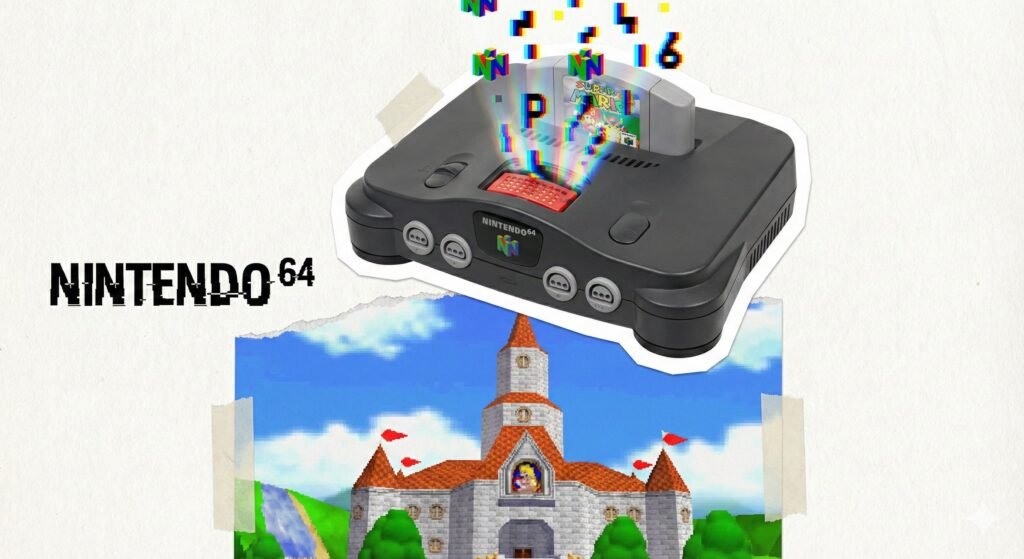

The Nintendo 64 wasn’t just a console—it was a rupture in the timeline. A moment where gaming’s future split into two realities: Sony’s cinematic CD-ROM revolution and Nintendo’s stubborn, brilliant, polygon-warping vision of gameplay-first innovation. What emerged was a machine both flawed and divine, a strange artifact where some of the greatest ideas in gaming history took shape.
Welcome to a full dissection of the N64—where god (allegedly) resided.
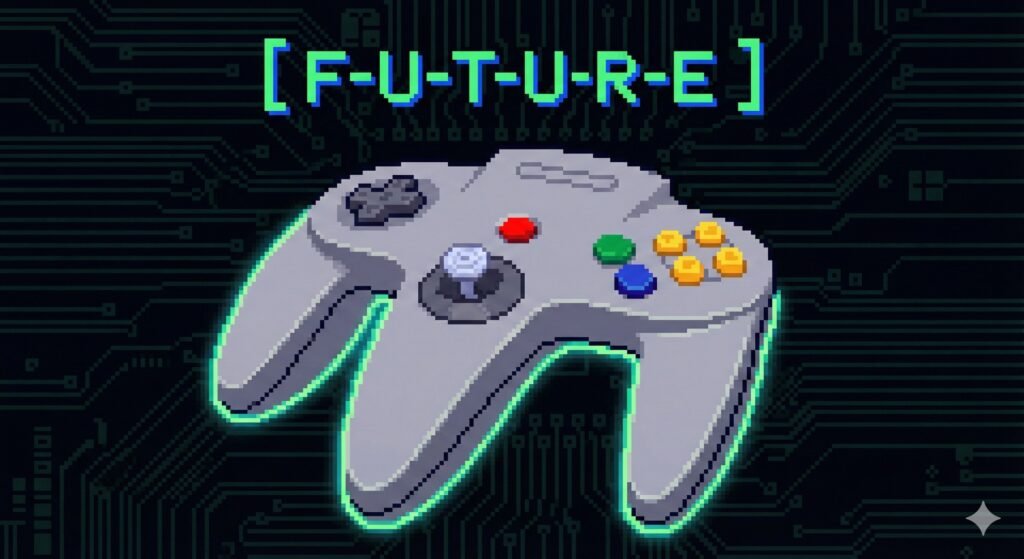
The Controller: Nintendo’s Beautiful, Bizarre Experiment
In 1996, the gaming world faced a wild fork in the road. PlayStation fans embraced the clean, modern CD-ROM era, while Nintendo doubled down on weirdness with one of the most peculiar input devices ever created: the three-pronged N64 controller.
Was it ergonomic genius or an alien artifact? Honestly—both.
Nintendo didn’t design this controller for comfort. They designed it for evolution. Its tri-handle silhouette enabled multiple grip styles depending on the game. The introduction of the analog stick and Z-trigger was nothing short of revolutionary. Within a year, these features became industry standards.
Then came the Rumble Pak, a chunky piece of haptic hardware that shook players for the first time. It wasn’t elegant, but it was undeniably alive—pure analog magic.
Cartridges vs. CDs: When Speed Beat Storage (But Still Lost)
While Sony’s PlayStation spun spacious, inexpensive CDs, Nintendo stayed faithful to the plastic cartridge. It was a bold decision—and the hill they ended up dying on.
Cartridge Strengths
- Instant load times
- Low piracy risk
- Rock-solid durability
This allowed games like Super Mario 64 to load with zero wait—astonishing at the time.
Cartridge Weaknesses
- High manufacturing costs
- Very limited storage space
- Poor support for cinematic video and CD-quality audio
This pushed developers toward Sony, who offered cheaper media and creative freedom for FMVs and lush soundtracks. Nintendo’s choice was technically superior yet commercially disastrous—a strategic glitch in an otherwise forward-thinking design.
The Golden Age: When the N64 Rewrote Gaming Itself
If the N64 stumbled in hardware philosophy, it more than redeemed itself with its software. Its library wasn’t enormous, but what it offered reshaped the future of gaming.
The N64 didn’t just influence 3D game design—it invented the language of it.
Super Mario 64
The blueprint for all 3D platformers. From movement physics to camera control, modern game design still follows its lead.
The Legend of Zelda: Ocarina of Time
The origin of modern 3D action-adventure gameplay. Its Z-targeting system remains a foundation for combat design decades later.
GoldenEye 007
The accidental legend that defined the console FPS. Its multiplayer mode became a cultural milestone—entire weekends evaporated in its split-screen arenas.
These weren’t just great games; they were transformative works that defined what video games could be in three dimensions.
The Architect of Modern 3D Gaming
The Nintendo 64 wasn’t perfect. Its decisions were bold, risky, and sometimes baffling. It lost third-party support, market share, and the optical media war.
But what it built—its mechanics, ideas, and philosophies—formed the foundation of the next 30 years of game design.
It didn’t win the generation. It won history.
On the N64, innovation wasn’t a feature—it was a place. A strange, gray, polygonal temple where god resided.