Write to us:

Computer viruses have shaped our digital world more than most realize. From playful experiments in the 1970s to global chaos in the 2000s, these self-replicating codes birthed cybersecurity as we know it. But what was the first computer virus? Was it a harmless prank or a malicious invader? In this deep dive, we’ll trace the “computer virus timeline” from John von Neumann’s theories to today’s stealthy threats, perfect for tech history buffs and anyone curious about how floppy disks sparked a multi billion dollar industry.
The Theoretical Spark: John von Neumann’s Self-Replicating Automata (1940s-1960s)
The idea of a “first computer virus” didn’t emerge from thin air. It started as a bold thought experiment by mathematician John von Neumann, often called the father of modern computing.
In the late 1940s, von Neumann delivered lectures at Princeton on Theory of Self-Reproducing Automata. Published posthumously in 1966, this paper imagined “mechanical organisms”, bits of code that could copy themselves, spread, and even sabotage hosts, mimicking biological viruses. Running on hypothetical cellular automata (grid based machines), these digital entities could evolve and destroy rivals.
- Key insight: Von Neumann proved self-replication was mathematically possible, laying groundwork for viruses, worms, and AI.
- Impact: No actual code ran then, computers were room sized behemoths, but it inspired hackers for decades.
This wasn’t malice; it was pure curiosity. Fast-forward to the 1970s, and theory met reality on early networks.
Creeper: The Harmless Prototype (1971)
Enter Creeper, widely regarded as the first real computer virus. Created by Bob Thomas at Bolt, Beranek and Newman (BBN) in 1971, it roamed the ARPANET, the U.S. military precursor to the internet.
Creeper was an experiment: Could a program self-replicate across machines? It could. Infecting DEC PDP-10 mainframes via the TENEX OS, Creeper hopped drives, displayed “I’m the Creeper, catch me if you can!” and tried to delete itself from old hosts. No damage, just proof of concept.
Ray Tomlinson, ARPANET’s email inventor, wrote Reaper, the first antivirus, to hunt it down. Lesson? Even “friendly” code spreads uncontrollably.
Wabbit (Rabbit): The First Malicious Crasher (1974)
By 1974, things turned nasty with Wabbit (or Rabbit). This Xerox Alto virus duplicated exponentially on Univac 1108 systems, spawning “rabbits” that clogged memory until crashes.
- How it worked: Forked processes ate CPU, no stealth—just brute force.
- Why “Rabbit”: Breeding like bunnies, it highlighted replication speed as a weapon.
Unlike Creeper, Wabbit aimed to disrupt. It foreshadowed resource exhausting attacks still common today.
ANIMAL and PERVADE: The Dawn of Trojans (1975)
Debate swirls: Was ANIMAL the first Trojan? Programmer John Walker created it in 1975 as a 20 Questions game guessing animals. Popular on Univac mainframes, sharing meant mailing tapes.
To automate, Walker added PERVADE: It hid in ANIMAL, scanned directories, and copied itself everywhere. No harm, but it acted without consent textbook Trojan (named after the deceptive horse from mythology).
From Fourmilab’s archives: “PERVADE was a virus in the biological sense… self-reproducing without authorization.”
Brain: The First PC Virus and Pakistani Pioneers (1986)
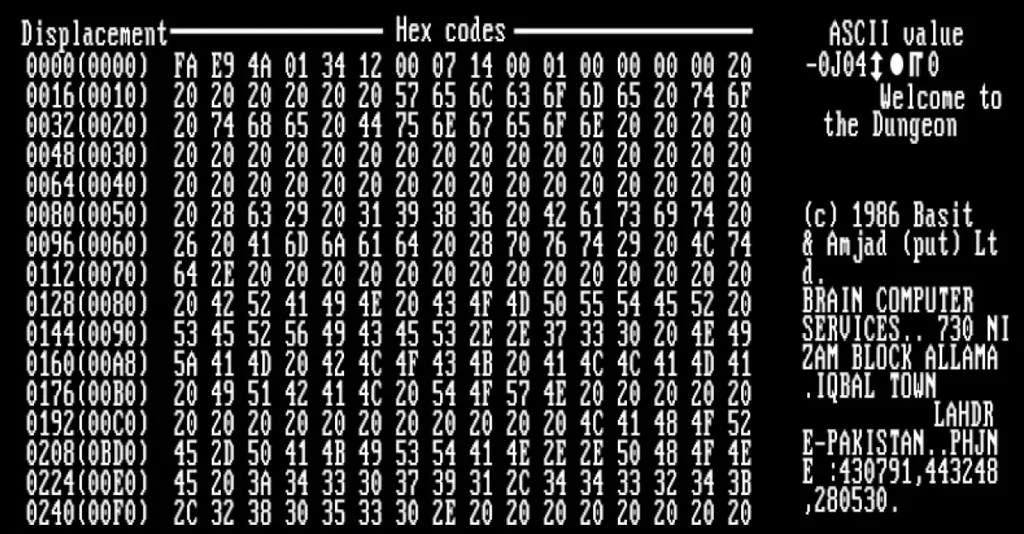
Now we hit the big one: Brain, the undisputed first PC virus. In Lahore, Pakistan, brothers Basit (19) and Amjad Farooq Alvi (24) ran Brain Computer Services. They sold medical software on 5.25″ floppies but hated piracy.
Their fix? Brain overwrote floppy boot sectors with viral code, hiding the original and adding a stealth message: “Welcome to the underground… Contact us for vaccination: Brain Computer Services, 7466 Old Airport Lahore, Pakistan. Phone: 430791, 42922, 42920.”
- Technical genius: Boot sector infector loaded pre-OS, evading detection. It relocated (not overwrote) data sophisticated for MS-DOS 2.0.
- Global spread: A demo floppy escaped to the U.S., hitting universities (Georgetown: 10,000 machines), newspapers, Hong Kong terminals, and Australia. By 1989, over 100,000 infections.
A late night call from a Miami journalist woke Amjad: “Is this the creator of that pesky program?” Time difference and broken English aside, chaos ensued. No data loss, but Brain birthed copycats.
Amjad later reflected: “We showed DOS flaws to friends. Didn’t think it’d go global.” They graced Time magazine in 1988. Fun fact for Eastern Europe fans: Brain echoed boot sector tricks in early Bulgarian Pravetz 8D viruses like “Yankee,” which spread via shared floppies in the late 80s amid communist tech isolation.
John McAfee read about it in the San Jose Mercury News: “Genius! No one thought of virus-like software.” He reverse engineered Brain, launched McAfee Antivirus, now a billion dollar empire.
Elk Cloner: The Mac Contender (1982)
Some argue Elk Cloner beat Brain. High schooler Rich Skrenta wrote it for Apple II in 1982. It infected floppies after five boots, flashing a poem: “Elk Cloner is the program for me / Virus protection is a joke so free…”
Non-destructive, but it pranked users. Brain still claims “first PC virus” title for IBM clones dominating by 1986.
The Email Era: ILOVEYOU and Code Red (2000)
Broadband flipped the script. Floppies yielded to emails.
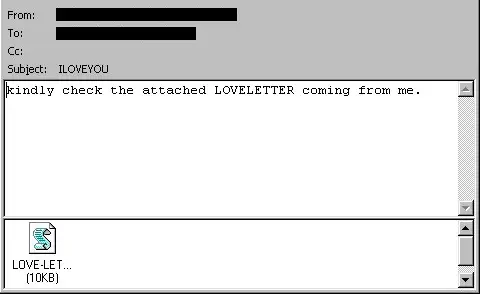
ILOVEYOU (May 4, 2000) by Filipino student Onel de Guzman ravaged 50 million PCs. Masquerading as “LOVE-LETTER-FOR-YOU.txt.vbs,” it overwrote files, emailed itself from contacts—social engineering gold. Damages: $15 billion. Onel? No jail time; lax laws.
Code Red (2001) was fileless, exploiting IIS buffers. In hours, 359,000 servers fell; it DDoSed whitehouse.gov. Cost: $2.6 billion.
Heartbleed: Vulnerability Masquerading as Virus (2014)
Not a virus, but Heartbleed felt like one. A OpenSSL bug let attackers dump 64KB RAM chunks usernames, keys, passwords. Affected 17% of HTTPS servers. Patch it? Two bytes flipped since 2012.
Bruce Schneier called it “catastrophic.” It showed crypto flaws rival viruses.
Modern Evolution and Lessons from the 80s-2000s
Viruses morphed: Macro (Melissa, 1999), ransomware (WannaCry, 2017), IoT botnets (Mirai, 2016). Motives shifted from vandalism to crime PoS hacks, Moker RATs bypassing AV.
In 80s-2000s nostalgia (MTV era meets dial-up), viruses were punk rock: Creeper taunted, Brain advertised. Today? State-sponsored like Stuxnet.
Protect yourself:
- Update everything.
- Use reputable AV (e.g., Malwarebytes).
- Spot phishing.
- Backup religiously.
The Future: AI-Driven Threats?
Viruses evolve with tech. Expect AI-generated polymorphic code, quantum-resistant malware, supply-chain attacks (SolarWinds, 2020). Defenses? Machine learning AV and zero-trust.
From von Neumann’s automata to Brain’s floppy plague, the first computer virus proved code lives. It infected our world for better (cybersecurity boom) and worse.